How family governance, professionalization, and leadership stability break the statistical barrier of generational survival.
The mortality rate of family businesses is one of the most ruthless statistics in the business world. Although they represent the backbone of the global economy, the transition of command and ownership is an abyss where most perish. However, the true factor of ruin is rarely the lack of market or product: it is the failure to manage succession as a strategic and continuous process, coupled with the illusion that the internal context can be controlled indefinitely.
One of the greatest mistakes made by founders and shareholders is believing that a harmonious family environment, or even a tight centralized control, is enough to guarantee the longevity of the business. The succession scenario (whether harmonious, conflictual, or traumatic) does not, by itself, ensure perennity. The reason is simple: the ENVIRONMENT variable is completely out of the control of the people involved and undergoes rapid and constant changes in markets, technologies, and macroeconomics. Without professional structures prepared to navigate these unstable waters, the company becomes fragile.
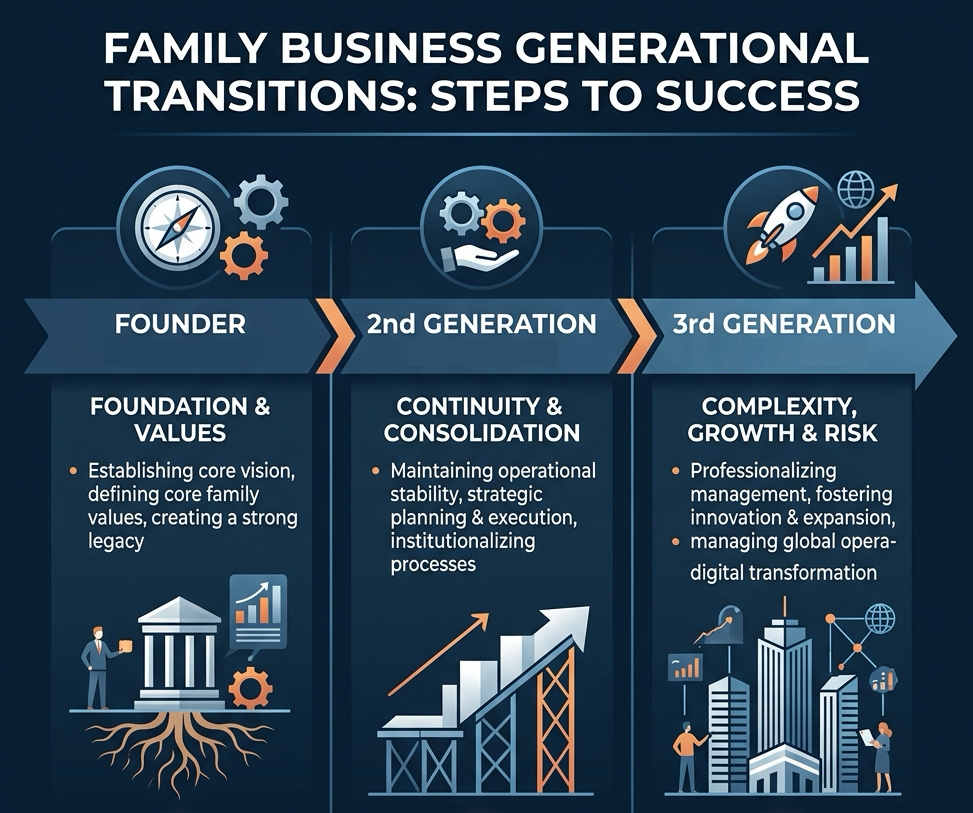
Generational Journey Infographic: from the entrepreneurial spirit and centralization of the founder to the cultural and corporate complexity of the third generation. (Ref: Northern Trust, 2017)
At the core of the transition of command lies a dangerous conceptual confusion between authority and legitimacy. Authority is an attribute of the position; it is imposed from top to bottom and generates passive obedience. On the other hand, legitimacy is earned; it is granted by the team and generates voluntary commitment and alignment of purpose.
To govern successfully, a new leader needs three pillars: vision of the future, legitimacy before subordinates, and, above all, emotional stability. The emotional instability of a senior leader or an unprepared successor is one of the fastest destroyers of corporate value. Instable leaders oscillate between obsessive micro-management and apathy, undermining organization-wide trust and paralyzing strategic decision-making. It is necessary to clearly point out the differences between an heir and a successor.
Talented, high-performing professionals do not work for salary alone; they want to be part of winning teams and predictable environments. When the leadership transition is treated amateurishly, generating internal instability or family political wars, a silent stampede occurs.
The best non-family executives — who have no blood ties and therefore no obligation to tolerate the chaos — leave the ship in search of more promising, stable, and merit-based environments. What remains is a weakened organizational structure, precisely at the moment when the new leadership most needs operational and technical support.
The dynamics of a family business change drastically as the family tree branches out. Each generational cycle brings specific cultural and relational challenges that alter governance:
This is the period of conception and consolidation. The founder carries the business DNA, often operating in a highly centralized and intuitive manner. Their decisions are fast, based on practical experience and deep personal values that shape the company's initial culture. Legitimacy here is unquestionable.
Members raised under the same roof, sharing very similar values. As siblings, they are used to individual differences since childhood. This increases the likelihood of accepting unequal responsibilities and remuneration, as there is a history of living together. However, they are often raised in a scenario of financial abundance without having gone through the hardships that forged the founder's resilience, and may or may not possess a true vocation for management.
Here, complexity explodes exponentially. Grandchildren were raised in different family units and cultural environments. The number of shareholders and heirs multiplies, dispersing control. Without rigid rules, conflicts of interest over dividends versus reinvestment stall the business. Thousands of successful companies do not survive this transition and end up in litigious corporate breakups or forced asset sales.

The Relay of Leadership: The importance of preparation and letting go at the exact moment of passing the baton. (Ref: CFEG Cambridge, 2018)
One of the biggest sources of conflict in family businesses is the inability to separate the remuneration of capital from the remuneration of time.
Family members often confuse ownership rights (being a shareholder) with management rights (working in the company). To shield the operations, it is imperative to establish a clear policy based on two distinct concepts:
Applying this division strictly prevents heirs without vocation or technical competence from using executive positions merely as a "job cabal" to inflate their personal earnings, which compromises cash flow and efficiency.

Comparative Table: Differences in rights, duties, and calculation criteria between the Shareholder (Capital) and the Executive (Time/Labor). (Ref: CFEG & Northern Trust, 2017)
Business perenny requires the coordinated implementation of three essential disciplines:
Competent successors are not born ready; they are built through rigorous development paths. Professionalization requires the family to recognize its own technical limitations. Heirs must be prepared to act in two distinct fronts: as responsible shareholders (understanding finance, governance, and reading balance sheets) or as executive managers (if they pass selection processes and prove real competence)1.
The ideal path involves rotating the successor through different areas and subsidiaries of the company, allowing them to earn legitimacy with their own effort and understand the end-to-end dynamics before assuming senior roles.
For many founders, the company is their alter ego — a direct extension of their personal identity. Stepping away from daily command triggers an existential fear of physical and mental obsolescence. The transition, however, must be viewed as a relay race: if the current leader runs fast but refuses to release the baton, or if the successor is not running at the same speed at the time of delivery, the baton drops and the race is lost.
The founder must actively plan their "next chapter" in life (assuming the chairmanship of the board, starting new ventures, or dedicating themselves to mentoring/philanthropy), ensuring space and real autonomy for the new leader to command without suffering unconscious interference or sabotage.
Corporate governance serves as the containment barrier that prevents family passions and disputes from contaminating executive board meetings. The main instruments are:
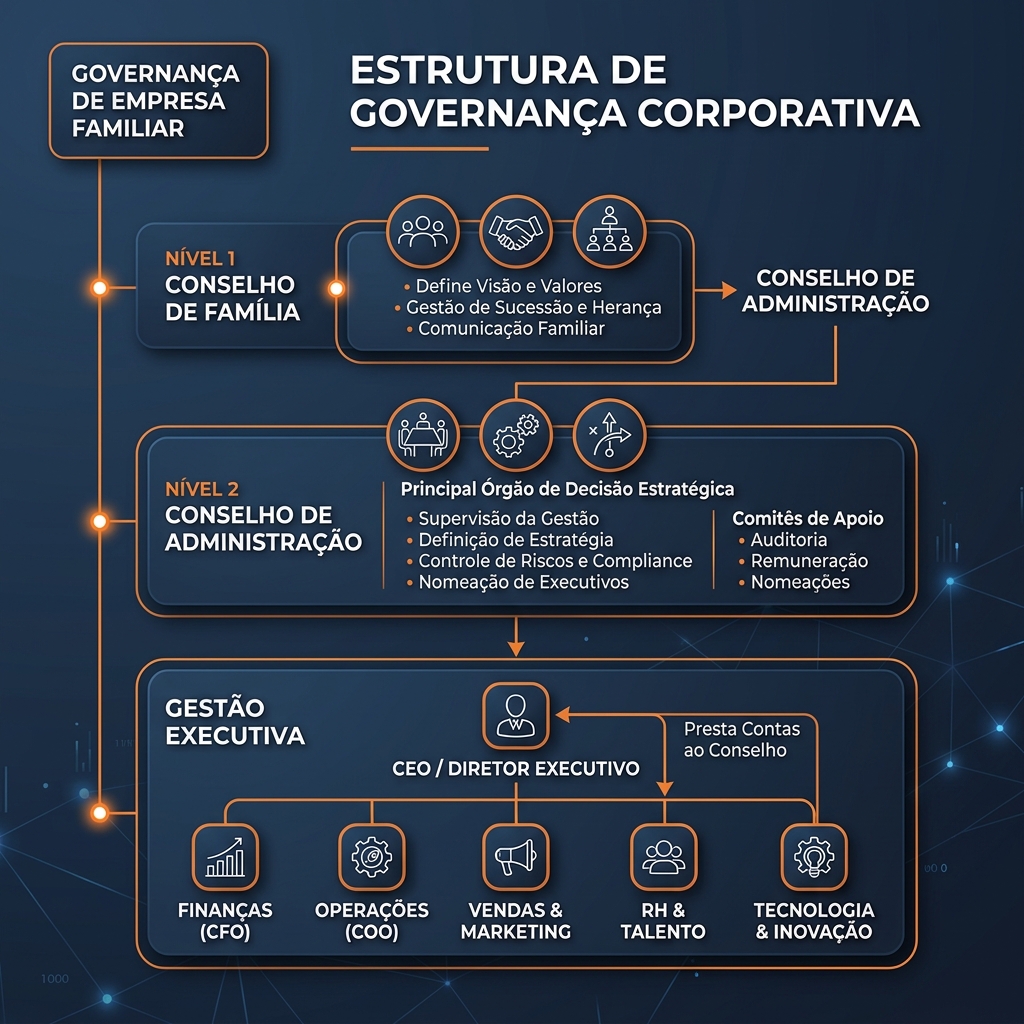
Governance Flowchart: The clear division between the Shareholders' Meeting, the Family Council, the Board of Directors, and the Executive Management. (Ref: HBS Board Effectiveness, 2017)
The preparation of an heir must be insulated from the parent-child dynamics, which are often loaded with emotional noise. It is highly recommended to rely on the mentorship of trusted external professionals — such as the company's CFO or independent board members. These mentors provide transparent and technical feedback, guiding the successor in mastering complex finances and soft leadership skills without the conflicts inherent in filial relationships.
A brilliant, practical example of how to legitimize a generational transition and introduce profound innovations without breaking corporate identity is the case of the Italian design brand Alessi. The leadership transition at Alessi teaches valuable lessons on the importance of narrative legitimacy:
When Alberto Alessi took over leadership in the 1970s, his goal was to transform a traditional metal foundry into a global powerhouse of innovative design. To achieve this radical change without facing internal backlash or being accused of nepotism by long-standing employees, Alberto adopted key narrative strategies:
Postponing succession planning is directly flirting with financial collapse. Studies compiled by NotebookLM reveal the severity of the situation:
Studies indicate that less than 12% of family businesses survive to the third generation (grandchildren). The decline sharpens drastically after the founder leaves.
Only about 40% of family businesses have a structured and formalized succession plan. Most treat succession as an emergency event rather than a process.
Companies that execute a planned and successful CEO transition generate a Total Shareholder Return (TSR) up to 3 times higher than companies that delay succession or hire poorly.
Although governance and corporate structuring are fundamental, practice in the Brazilian business environment shows that the greatest succession challenges usually arise long before the formalization of processes. The main bottleneck, in reality, is behavioral and emotional.
Brazilian culture has a strong inclination towards avoiding direct conflicts, prioritizing the preservation of personal relationships over operational clarity. This tendency generates chronic dysfunctions: family members in positions unsuited to their competencies, chronically protected low-performing heirs, external executives without real autonomy for honest feedback, and partners who avoid discussing remuneration, governance, and succession. The conflict does not disappear — it accumulates silently until it explodes in an unstructured way during the succession process.
The challenge of letting go takes on even more dramatic contours in Brazil. Most pioneers built their businesses under historically adverse conditions — hyperinflation, economic instability, credit scarcity, and legal insecurity —, which forged a mentality of absolute control and centralization. The classic argument — "If I got here doing it this way, why change?" — collides with the demands of the modern market for delegation, active governance, decision-making agility, and talent attraction.
Rarely admitted, vanity is a factor underlying a large part of succession failures. It manifests itself in the feeling of irreplaceability, in the belief that no one knows the business like the founder, or that the company will lose its identity without their daily supervision. True corporate longevity, however, belongs to organizations capable of operating autonomously. The leader who cannot strategically withdraw from center stage inadvertently becomes the greatest governance risk to their own business.
An effective alternative to face these behavioral blocks towards professionalization is the establishment of an Advisory Board. Unlike the Board of Directors — which has formal deliberative power —, the Advisory Board acts as a space for listening, mentoring, and qualified dialogue, without directly threatening the founder's authority. For larger companies, it represents a natural intermediate step towards more structured governance. For smaller companies, it can be a definitive body, positioned between a new professional management (which may include qualified family members) and the Family Council. Its composition with external and independent members creates the safe environment necessary for sensitive topics — performance, succession, letting go — to be handled with the objectivity that internal relationships rarely permit.
Succession in family businesses is not an isolated corporate event, but a strategic, educational, and psychological journey. Although robust governance, professionalization, and the current leader's emotional maturity do not guarantee control over the external environment — which will keep shifting rapidly —, they secure the resilience and internal legitimacy required for the company to adapt and thrive across generations.
In the Brazilian corporate scenario, the greatest succession risk is not the lack of governance, capital, or qualified heirs, but the family business's inability to converse honestly about its own limitations or even recognize them, often blinded by vanity. In this context, families frequently embark on governance journeys without properly formalizing the objectives and rules of their family and advisory boards. By clinging to the illusion of “maintaining flexibility,” they adopt a posture that almost always leads to misunderstandings and the failure of the process. Family businesses rarely die from technical problems; they die because their leaders postpone difficult decisions until time turns them into inevitable crises.
This perspective speaks directly to the reality of many Brazilian family businesses, where the central challenge is not merely structural, but deeply human. Governance organizes processes; succession, however, only truly begins when those involved are willing to face the truths they would prefer to avoid. The true value of a business lies not just in today's tangible assets or fiscal results, but in the maturity and intelligence with which the organization plans the passing of the baton to safeguard and expand its legacy for tomorrow.